Our collective cohesion and security as a nation and as a culture is under severe pressure from a range of systemic, international and non-state actors that are attempting to intervene in the life of British communities like never before.
Historically, communities would gather at the the church or the pub in order to participate in local life. If we recognise that communities of people that work together are more resilient than individuals and agree that these institutions are no longer central to our way of life, then new alternatives must be forged. Even without the other threats that seek to divide our stable democratic communities, climate change is likely to wreak havoc and bringing catastrophic heating events, major storms, winds and flooding. Physical, economic, social and community resilience is more important than ever and power must be built from the bottom, up.
Dale Carnegie said that ‘Human beings are not creatures of logic; we are creatures of emotion. And we do not care what's true. We care how it feels’.
How we feel has been long overlooked as a factor and the last 100 years of development of British towns and villages can be summarised by the spatial and cultural influence of the motor car. The car, for all its logistical value is a potent symbol of individualism and a disconnection from place and environment. Communities have been shaped by the ontological designing of the age of the car and Urban Design has not reflected the human emotional experience. In the future, it must. Not because humanity should be prioritised as a species, but because we must become responsible stewards of places, attuned to and cognisant of our environment, aware of the intangible connections present in landscape, ecology and community. As Urban Designers, we must become better listeners;“Truth appears as a spark, an ephemeral sound, a silence, never permanent, always an evanescent encounter” (Alberto Perez Gomez)
As we watch the rapid urbanisation of the Middle East and Asia, it is easy to forget how long change can take in British places; including the land purchase, design and planning process, 5-8 years is widely accepted in industry as a normal timeframe for end to end delivery of large projects. While trying urgently to compress this timeline, we must stay true to our democratic values, deepen participatory design processes and remain conscious of effectiveness and efficiency in design, we must do More Good built environment projects that embed physical and community resilience in places. Decisions made now will be locked in for a generation so projects must always seek to “eliminate waste and pollution, circulate products and materials (at their highest value), and regenerate nature.”
In Flourish by Ichioka & Pawlyn; the themes of place, participation, belonging and systems thinking converge in a question; “What does nature want us to do?” I think that a parallel question in Urban Design needs to be ‘What does our nature want us to do?” and I believe that if we listen we will get some magical insights.
As stewards, listeners and designers, Mcdonough proposed we must value ecology, economy, equity but to access the magic, I believe we must also value the ethereal:
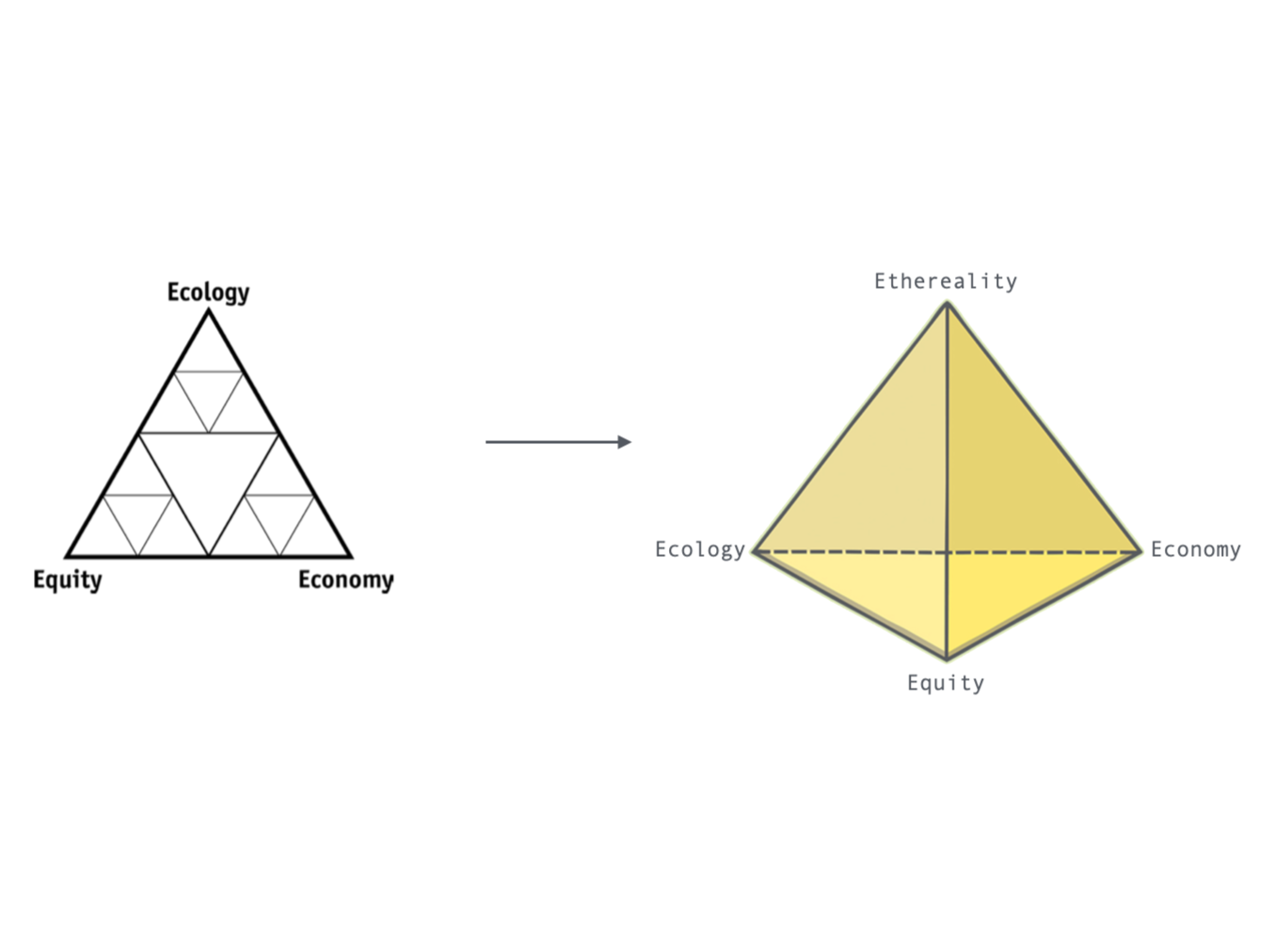
It has been fascinating to understand that even deep within the biomimicry debate where all parties advocate for the idea of zero waste industry, closed loop circular resource systems and rewilding there still remains a disagreement over ‘limits to growth’ as described by Donella Meadows in 1972.
Please see Bibliography below
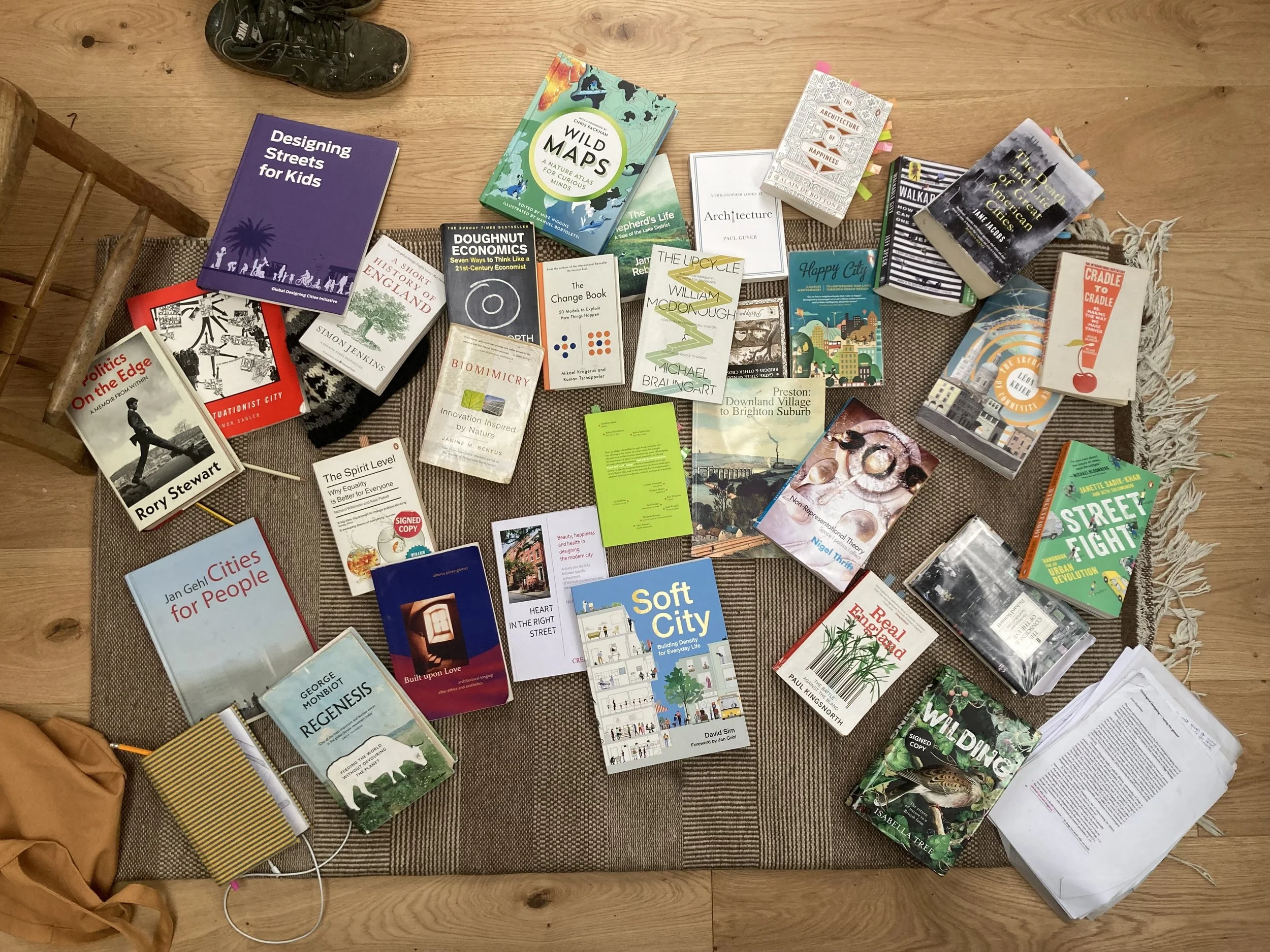
Bibliography
Bangs, David. Preston: Downland Village to Brighton Suburb. Brighton: Brighton Books, 2004.
Benyus, Janine M. Biomimicry: Innovation Inspired by Nature. New York: Harper Perennial, 2002.
Boys Smith, Nicholas. Heart in the Right Street: Beauty, Happiness and Health in Designing the Modern City. London: Create Streets, 2016.
Burton, Elizabeth, and Lynne Mitchell. Inclusive Urban Design: Streets for Life. Oxford: Architectural Press, 2006.
De Botton, Alain. The Architecture of Happiness. London: Penguin Books, 2006.
Flyn, Cal. Islands of Abandonment: Life in the Post-Human Landscape. London: Viking, 2021.
Gehl, Jan. Cities for People. Washington, DC: Island Press, 2010.
Harrington, Mary. Feminism against Progress. London: Swift Press, 2023
Jacobs, Jane. The Death and Life of Great American Cities. New York: Random House, 1961.
Jenkins, Simon. A Short History of England. London: Profile Books, 2011.
Kingsnorth, Paul. Real England: The Battle against the Bland. London: Portobello Books, 2008.
Krier, Léon. The Architecture of Community. Edited by Dhiru A. Thadani and Peter J. Hetzel. Washington, DC: Island Press, 2009.
Krogerus, Mikael, and Roman Tschäppeler. The Change Book: Fifty Models to Explain How Things Happen. London: Profile Books, 2013.
McDonough, William, and Michael Braungart. Cradle to Cradle: Remaking the Way We Make Things. New York: North Point Press, 2002.
Mcdonough, William. The Upcycle: Beyond Sustainability—Designing for Abundance. New York: North Point Press, 2013.
Monbiot, George. Regenesis: Feeding the World without Devouring the Planet. London: Allen Lane, 2022.
Montgomery, Charles. Happy City: Transforming Our Lives through Urban Design. London: Penguin Books, 2013.
Nathaniel Coleman, Lefebvre for Architects, Thinkers for Architects, London: Routledge, 2015.
Norberg-Schulz, Christian. Genius Loci: Towards a Phenomenology of Architecture. New York: Rizzoli, 1980
Pérez-Gómez, Alberto. Built upon Love: Architectural Longing after Ethics and Aesthetics. Cambridge, MA: MIT Press, 2006.
Raworth, Kate. Doughnut Economics: Seven Ways to Think Like a 21st-Century Economist. London: Random House Business Books, 2017.
Rebanks, James. The Shepherd's Life: A Tale of the Lake District. London: Allen Lane, 2015.
Sadik-Khan, Janette, and Seth Solomonow. Streetfight: Handbook for an Urban Revolution. New York: Viking, 2016.
Sadler, Simon. The Situationist City. Cambridge, MA: MIT Press, 1998.
Sennett, Richard. The Conscience of the Eye: The Design and Social Life of Cities. New York: Alfred A. Knopf, 1990.
Shepheard, Paul. What Is Architecture? An Essay on Landscapes, Buildings, and Machines. Cambridge, MA: MIT Press, 1994.
Sim, David. Soft City: Building Density for Everyday Life. Washington, DC: Island Press, 2019.
Speck, Jeff. Walkable City: How Downtown Can Save America, One Step at a Time. New York: North Point Press, 2012.
Stewart, Rory. Politics on the Edge: A Memoir from Within. London: Jonathan Cape, 2023.
Thrift, Nigel. Non-Representational Theory: Space, Politics, Affect. London: Routledge, 2008.
Tree, Isabella. Wilding: The Return of Nature to a British Farm. London: Picador, 2018.
Wilkinson, Richard, and Kate Pickett. The Spirit Level: Why Equality Is Better for Everyone. London: Allen Lane, 2009